

Aug
MAA Blog, Aquatic Health and Diseases, Aquatic Life Care
Aquarium Water Change Guide: 7 Essential Steps for Healthy Fish
Introduction
Water may look clean, but clear aquarium water is not necessarily healthy aquarium water.
Fish constantly release waste into their environment. Uneaten food, decaying organic matter and biological processes also affect water chemistry. Your aquarium filter helps process waste, but it does not remove every substance that gradually accumulates.
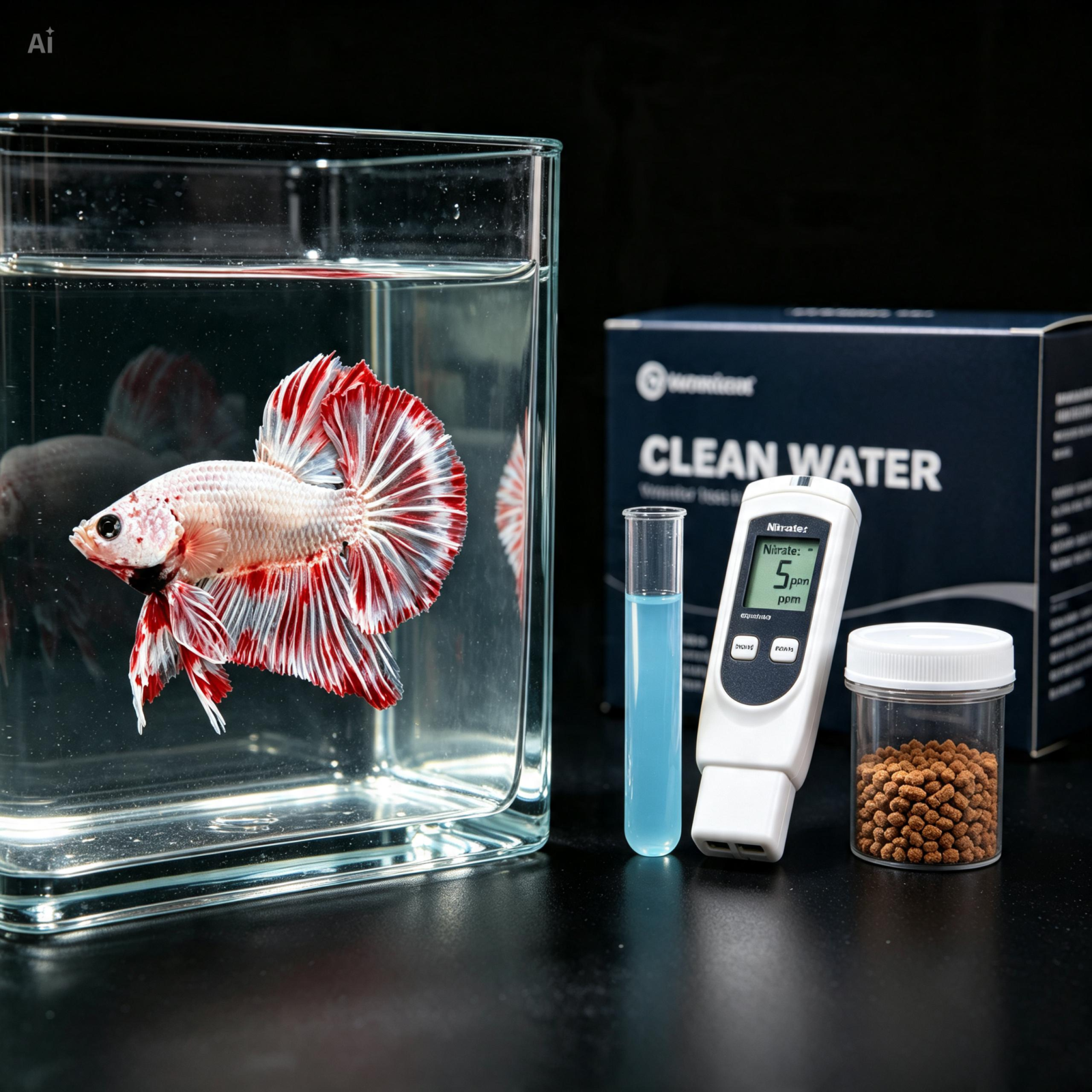
That is why regular water changes are one of the most important maintenance routines for aquarium fish.
This aquarium water change guide explains how water changes work, how much water you should replace, how often you should do it, how to prepare new water safely, and how to avoid common mistakes that can stress your fish.
For betta keepers, water changes are particularly important because a small aquarium can experience changes in water chemistry faster than a larger, well-established system.
Merck Veterinary Manual identifies poor water quality as a major cause of environmental disease in fish and recommends routine monitoring of important parameters such as chlorine, pH, temperature and salinity where applicable.
A good water-change routine is therefore not simply about making the aquarium look cleaner.
It is about removing accumulated waste and maintaining a stable aquatic environment.
Aquarium water change principle: Don’t change water simply because the calendar says so. Test the water, understand your aquarium’s biological load, and build a consistent maintenance routine.
What Is an Aquarium Water Change?
An aquarium water change means removing some of the existing aquarium water and replacing it with appropriately prepared new water.
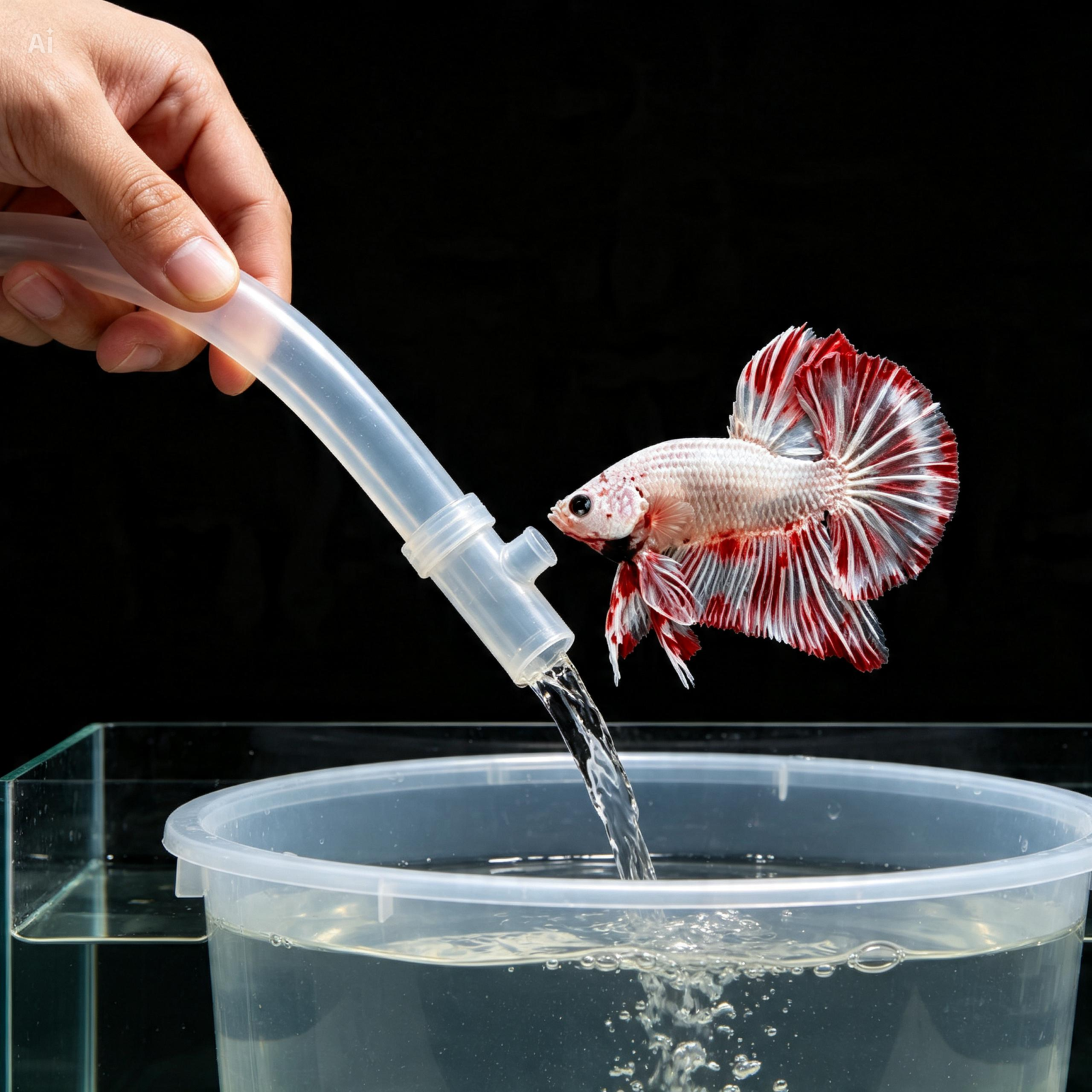
The key word is partial.
You usually do not need to empty the entire aquarium every time you perform routine maintenance.
For example, if your aquarium contains 10 litres of water and you replace 30%, you remove approximately 3 litres and replace it with approximately 3 litres of properly prepared water.
The purpose is to dilute accumulated substances while maintaining the biological environment inside the aquarium.
These substances can include:
- Nitrate
- Dissolved organic compounds
- Metabolic waste
- Fine debris
- Other dissolved substances
Water changes can also help correct certain water-quality problems.
Merck explains that nitrate is ultimately removed from aquarium systems through mechanisms including water changes, while inadequate water changes can contribute to the accumulation of organic acids and deterioration of water chemistry.
Why Are Aquarium Water Changes Important?
1. They Help Control Waste
Fish continuously produce waste.
Ammonia is released directly by fish and enters the aquarium’s nitrogen cycle. Beneficial microorganisms then convert ammonia into nitrite and eventually nitrate.
The process is essential, but it does not mean waste disappears completely.
Nitrate can continue accumulating.
Regular water changes help physically remove some of those dissolved substances from the aquarium.
2. They Help Control Nitrate
Nitrate is less immediately toxic than ammonia and nitrite, but excessive accumulation can still become a water-quality concern.
Water changes are one of the practical ways to reduce nitrate concentration.
This is particularly important in:
- Small aquariums
- Heavily stocked tanks
- Heavily fed tanks
- Breeding systems
- Fish rooms
- Aquariums with limited plant growth
The more waste your aquarium produces, the more carefully you need to manage water quality.
3. They Help Maintain Water Chemistry
Aquarium water chemistry gradually changes as biological processes occur.
Over time, buffering capacity can be depleted.
Merck describes old tank syndrome, where inadequate water changes can contribute to organic acid accumulation, depletion of buffering capacity and eventually a significant fall in pH.
This is one reason simply topping up evaporated water is not the same as performing a water change.
4. They Remove More Than Your Filter Can
Your filter is extremely important.
However, a filter does not mean you never need to change water.
Mechanical filtration can trap particles.
Biological filtration provides surfaces for beneficial microorganisms.
But water changes physically remove dissolved substances from the aquarium.
The RSPCA explains that biological filtration converts ammonia to nitrite and eventually nitrate, and recommends regular partial water changes to dilute waste products that the biological filter does not remove.
Think of the filter and water change as two different maintenance tools.
You need both.
How the Aquarium Nitrogen Cycle Works
Understanding the nitrogen cycle makes water changes much easier to understand.
The simplified process looks like this:
Fish waste / decomposing food
↓
Ammonia
↓ beneficial bacteria
Nitrite
↓ beneficial bacteria
Nitrate
↓ water changes / plants / other biological processes
Lower concentration
Fish continuously produce waste, while beneficial bacteria process nitrogenous compounds.
According to Merck Veterinary Manual, ammonia released by fish is metabolized by environmental bacteria and converted to nitrite and then nitrate.
This is why maintaining a healthy biological filter is important.
But remember:
A cycled aquarium still needs water changes.
A mature biological filter helps process ammonia and nitrite. It does not magically remove every dissolved substance from the aquarium.
How Much Water Should You Change?
There is no single percentage that is perfect for every aquarium.
The appropriate amount depends on:
- Tank size
- Number of fish
- Fish size
- Feeding level
- Filtration
- Plant growth
- Water parameters
- Aquarium age
- Nitrate accumulation
- Maintenance history
For a normal, stable aquarium, a moderate partial water change is a practical starting point.
The RSPCA recommends weekly 30% water changes as a general guideline for aquarium fish.
However, do not treat 30% as a universal law.
A lightly stocked, heavily planted mature aquarium may have different requirements from a heavily stocked breeding tank.
Likewise, an aquarium experiencing ammonia or nitrite toxicity may require a much larger or more frequent intervention.
Merck notes that when high ammonia is detected, a water change of 50% or more may be appropriate in certain circumstances, while also emphasizing that source-water ammonia or chloramine must be considered.
Simple guide
| Aquarium Situation | Practical Approach |
|---|---|
| Stable, lightly stocked aquarium | Regular moderate partial changes |
| Normal community aquarium | Often around 20–30% weekly as a starting routine |
| Small betta aquarium | Monitor parameters and establish a consistent schedule |
| Heavily stocked aquarium | More frequent changes may be necessary |
| Breeding/grow-out system | Monitor closely; waste load can be high |
| High ammonia/nitrite | Test immediately and perform appropriate corrective water changes |
| Long-neglected aquarium | Correct gradually when appropriate rather than blindly replacing everything |
Testing should guide your routine.
How Often Should You Change Aquarium Water?
A common beginner question is:
“Do I need to change the water every week?”
Often, weekly maintenance is a useful starting point.
But aquarium maintenance should ultimately be based on water quality and biological load, not just the calendar.
Consider changing water more frequently when:
- Nitrate rises quickly
- Fish are heavily stocked
- You feed heavily
- The aquarium is very small
- There is significant organic debris
- Fish are breeding
- Ammonia or nitrite is detected
- The filter is overloaded
- Fish show signs associated with poor water quality
You may need less frequent changes when:
- The aquarium is mature
- Stocking is low
- Feeding is controlled
- Plants actively use nutrients
- Water parameters remain stable
- Nitrate accumulation is slow
Nevertheless, beginners generally benefit from having a consistent weekly testing and maintenance routine rather than waiting until the water looks dirty.
Step-by-Step Aquarium Water Change Guide
Step 1: Test the Aquarium Water
Before changing water, test important parameters when appropriate.
For a freshwater aquarium, useful tests include:
- Ammonia
- Nitrite
- Nitrate
- pH
- Temperature
Merck recommends routine water-quality monitoring and testing before adding fish and as part of ongoing aquarium maintenance.
Testing gives you information that your eyes cannot provide.
Step 2: Prepare the New Water
Prepare replacement water before removing aquarium water.
This is especially important when using tap water.
Tap water can contain chlorine or chloramine, both of which are toxic to fish and the beneficial bacteria in your aquarium.
Merck recommends using a suitable dechlorinator to treat new tap water before it enters the aquarium.
Basic principle:
Tap water → Treat → Adjust temperature → Add to aquarium
Do not assume that water is safe simply because it looks clear.
Step 3: Match the Temperature
Large temperature differences can stress fish.
The replacement water should be reasonably close to the aquarium temperature.
This does not mean you need laboratory-level precision for every routine change.
The goal is to avoid introducing a large sudden temperature shift.
For betta fish, stable warm water is particularly important because they are tropical freshwater fish.
Step 4: Remove the Old Water
Use a suitable siphon or aquarium hose.
Remove the planned percentage of water.
During the process, you can gently remove visible debris from the substrate.
Avoid aggressively disturbing the entire aquarium.
Step 5: Clean the Substrate
If your aquarium has gravel or another suitable substrate, gently siphon areas where waste accumulates.
You do not need to deep-clean every section of substrate every time.
A useful approach is to work systematically.
For example:
Week 1: front-left area
Week 2: front-right area
Week 3: rear-left area
Week 4: rear-right area
This can help maintain the aquarium without excessively disturbing the entire substrate at once.
Step 6: Refill Slowly
Add the prepared water gradually.
Avoid blasting the substrate or fish with a strong stream of water.
You can pour water onto a clean plate, plastic bag or suitable surface to disperse the flow.
The objective is simple:
Refill without creating unnecessary disturbance.
Step 7: Check the Aquarium
After refilling:
- Check the water level
- Check temperature
- Confirm the filter is running
- Check water movement
- Observe the fish
- Check for leaks
- Make sure equipment is functioning normally
The aquarium should settle back into its normal operating condition.
How to Change Betta Fish Water
Betta fish are often kept in smaller aquariums, which means water chemistry can change more quickly when the biological load is high.
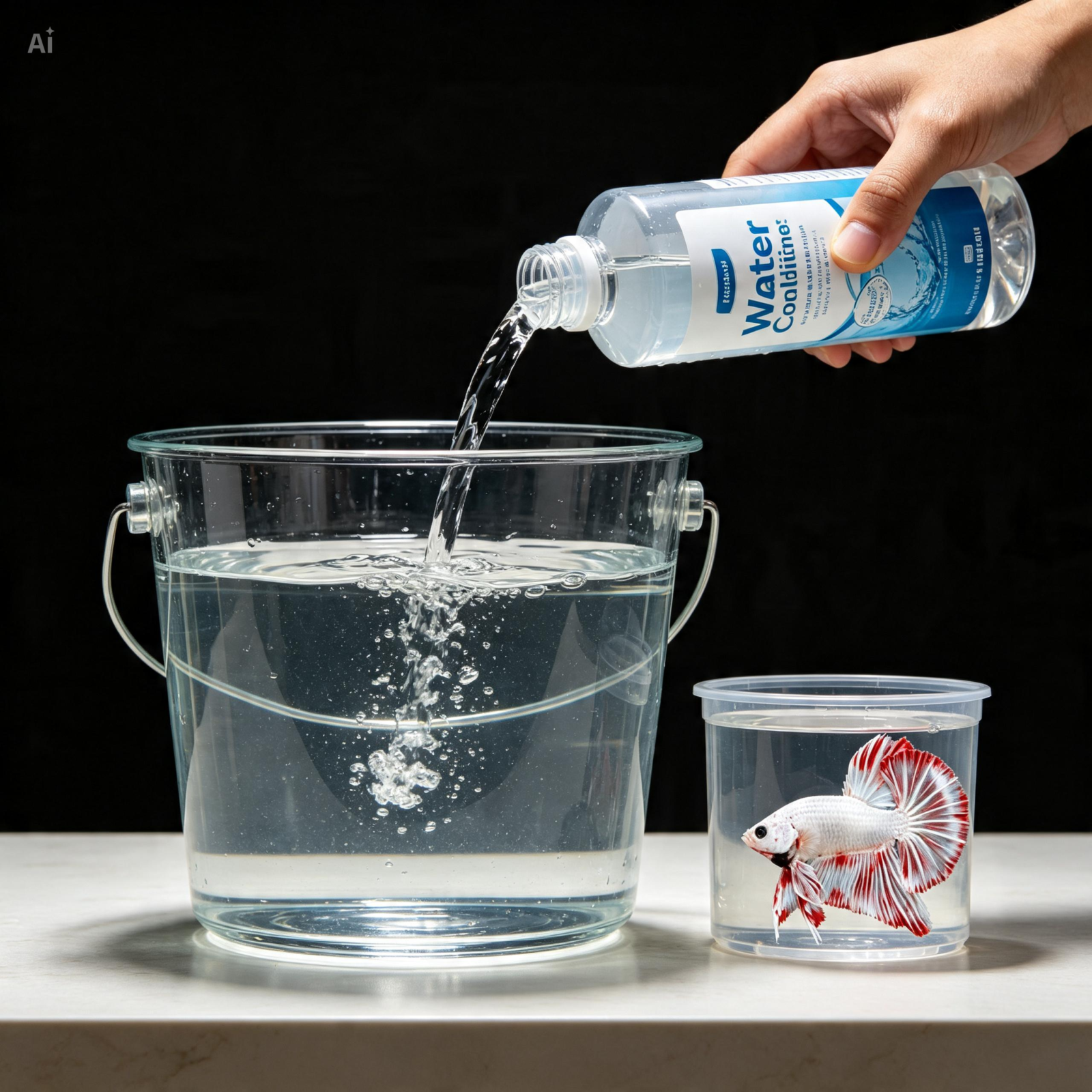
A simple routine is:
1. Test
Check ammonia, nitrite and nitrate when appropriate.
2. Prepare
Treat the replacement water with an appropriate water conditioner.
3. Match temperature
Avoid sudden temperature changes.
4. Remove part of the water
Use a small siphon or suitable container.
5. Remove debris
Gently clean visible waste.
6. Refill slowly
Avoid stressing the fish.
7. Observe
Watch your betta for normal swimming and breathing.
Do not use a water change as an excuse to completely sterilize the aquarium every week.
A healthy aquarium is a living ecosystem.
Your goal is maintenance—not destruction and rebuilding.
Should You Remove the Fish During a Water Change?
For routine partial water changes, removing the fish is generally unnecessary.
Keeping the fish in the aquarium avoids the additional handling associated with catching, transferring and returning it.
Instead:
- Work slowly
- Avoid chasing the fish
- Keep the water level safe
- Use equipment carefully
- Prevent the fish from being sucked into the siphon
If the aquarium must be completely dismantled for a specific reason, that is a different situation.
For routine maintenance, however, minimizing handling is usually preferable.
What About the Aquarium Filter?
This is where many beginners accidentally damage their aquarium’s biological stability.
Your filter media can contain beneficial microorganisms that help process nitrogenous waste.
The RSPCA specifically advises cleaning filter media using aquarium water removed during a water change rather than tap water, because tap water can harm beneficial bacteria.
Avoid this:
Remove sponge → wash aggressively under tap → reinstall
Instead:
Remove aquarium water → gently rinse/squeeze filter media in that old aquarium water → reinstall
Do not replace every piece of biological filter media at once unless there is a specific reason to do so.
Water Change vs Top-Off
These are not the same.
Top-Off
You replace water lost through evaporation.
Water evaporates.
Most dissolved minerals and substances remain behind.
Therefore, topping up restores the water level but does not remove accumulated waste.
Water Change
You physically remove aquarium water and replace it with prepared water.
This helps reduce dissolved waste and replenish the system.
Simple example
If 1 litre evaporates from a 10-litre aquarium, adding 1 litre of water restores the level.
But it does not remove the nitrate that accumulated in the aquarium.
That requires actual water removal and replacement.
Can You Change 100% of the Aquarium Water?
A 100% water change is not normally necessary for routine maintenance.
Completely replacing aquarium water can create major changes in:
- Temperature
- pH
- Hardness
- Dissolved substances
- Microbial environment
In certain emergencies, disease-management situations or complete system resets, a large or complete water replacement may be appropriate.
But it should not be the default weekly cleaning method.
Merck describes situations such as severe old tank syndrome where a system may require much more extensive intervention, but this is very different from ordinary maintenance.
Emergency Water Changes
Water changes are particularly important when water tests reveal dangerous conditions.
High Ammonia
Ammonia can be highly toxic to fish.
Merck notes that ammonia toxicity depends on factors including pH and temperature because the proportion of toxic unionized ammonia increases as pH and temperature rise.
If ammonia is elevated:
- Stop or reduce feeding temporarily.
- Test the water.
- Check the filter.
- Check for dead fish or decaying material.
- Perform an appropriate water change.
- Test the replacement water.
- Investigate the underlying cause.
Do not simply keep changing water without finding out why ammonia is increasing.
High Nitrite
Nitrite is another toxic nitrogen compound.
If nitrite rises:
- Test the water.
- Perform an appropriate water change.
- Check biological filtration.
- Reduce feeding.
- Check stocking levels.
- Investigate possible filter failure.
Merck recommends water changes and filter maintenance as part of correcting nitrite problems in aquariums and ponds.
Common Aquarium Water Change Mistakes
Mistake 1: Using Untreated Tap Water
Chlorine and chloramine can harm fish and beneficial bacteria.
Better: Always treat replacement water appropriately.
Mistake 2: Changing Water Only When It Looks Dirty
Clear water can still contain ammonia, nitrite or elevated nitrate.
Better: Test the water.
Mistake 3: Doing Huge Changes Every Week
A massive routine change may create unnecessary instability.
Better: Establish a consistent partial-water-change routine.
Mistake 4: Never Changing Water Because You Have a Filter
A filter is not a substitute for water changes.
Better: Use filtration and water changes together.
Mistake 5: Washing Filter Media Under the Tap
This can damage beneficial bacteria.
Better: Rinse biological media gently in removed aquarium water.
Mistake 6: Changing All Filter Media at Once
This can remove a significant portion of the biological filtration capacity.
Better: Maintain filter media gradually and strategically.
Mistake 7: Forgetting Temperature
Cold or significantly different replacement water can stress tropical fish.
Better: Prepare replacement water at an appropriate temperature.
Mistake 8: Overcleaning
Scrubbing every surface, replacing all media and removing all substrate debris can unnecessarily disrupt the aquarium ecosystem.
Better: Maintain the system rather than trying to make it sterile.
Common Myths
| Myth | Fact |
|---|---|
| If water is clear, it is healthy. | Clear water can still contain ammonia, nitrite or excessive nitrate. |
| The filter removes everything. | Biological filtration processes nitrogenous waste but does not eliminate every dissolved substance. |
| Topping up is the same as a water change. | Topping up replaces evaporated water but does not remove accumulated waste. |
| You must change 100% every week. | Routine maintenance usually involves partial changes; the appropriate amount depends on the aquarium. |
| You should wash the filter under tap water. | Tap water can damage beneficial bacteria; aquarium water is safer for routine media cleaning. |
| More water changes are always better. | Water changes are valuable, but unnecessary extreme changes can create instability. |
| Fish should always be removed before changing water. | Routine partial changes can usually be performed with the fish remaining in the aquarium. |
| Water conditioner is optional for tap water. | Chlorine and chloramine can be toxic to fish and aquarium bacteria, so tap water should be appropriately treated. |
| Aquarium water needs to be completely sterile. | A healthy aquarium depends on a functioning biological ecosystem. |
| Plants eliminate the need for water changes. | Plants can help use nutrients, but they do not automatically eliminate the need for water changes. |
Frequently Asked Questions
1. How often should I change aquarium water?
For many beginner aquariums, a weekly partial water change is a practical starting point. The exact schedule should depend on stocking, feeding, filtration, plants and measured water parameters.
The RSPCA recommends weekly 30% water changes as a general aquarium guideline.
If nitrate rises quickly or ammonia/nitrite is detected, more frequent corrective maintenance may be necessary.
2. How much water should I change in an aquarium?
There is no single percentage that works for every aquarium.
A moderate partial change, such as around 20–30%, is a common starting point for a stable aquarium.
However, water-quality problems may require larger or more frequent changes.
The key is to combine a maintenance schedule with water testing.
3. How often should I change betta fish water?
A betta aquarium should have a consistent maintenance routine rather than waiting until the water becomes visibly dirty.
For many stable setups, a weekly partial water change is a reasonable starting point.
However, small tanks, heavy feeding, high stocking and inadequate filtration can require more frequent maintenance.
Test the water and adjust your schedule accordingly.
4. Should I remove my betta during a water change?
Usually, no.
For routine partial water changes, keeping the betta in the aquarium avoids unnecessary catching and handling.
Work carefully around the fish and use a siphon safely.
If the aquarium requires complete dismantling for a specific reason, temporary removal may be necessary.
5. Can I use tap water for an aquarium?
Yes, tap water can often be used, but it must be made suitable for aquarium use.
Municipal tap water may contain chlorine or chloramine, which can harm fish and beneficial aquarium bacteria.
Merck recommends treating new tap water with an appropriate dechlorinator before adding it to an aquarium.
Always consider your local water supply and test when necessary.
6. Should new aquarium water be the same temperature?
The replacement water should be reasonably close to the aquarium temperature.
Large temperature differences can stress fish.
For tropical fish such as bettas, prepare replacement water at an appropriate warm temperature rather than adding very cold tap water directly into the aquarium.
7. Does a water change remove beneficial bacteria?
A properly performed partial water change mainly removes water.
Most beneficial nitrifying bacteria live on surfaces such as filter media and other established aquarium surfaces rather than floating freely throughout the water column.
The bigger risk is aggressively cleaning or replacing biological filter media.
8. Should I clean my filter during every water change?
Not necessarily.
Clean the filter when flow is reduced or the media requires maintenance.
When cleaning biological media, use removed aquarium water rather than untreated tap water to reduce damage to beneficial bacteria.
Avoid unnecessary deep cleaning.
9. Why does my aquarium pH keep dropping?
A gradual pH decline can be associated with depletion of buffering capacity as biological processes and organic acids accumulate.
Inadequate water changes can contribute to this situation.
Merck describes this as part of old tank syndrome and recommends correcting the underlying water-quality problem rather than simply treating the symptom.
Test pH, alkalinity/KH where relevant, ammonia and other parameters before making major adjustments.
10. Can I do a water change if my fish is sick?
Often, maintaining good water quality is an important part of fish-health management.
However, the appropriate water-change strategy depends on the disease and water parameters.
If ammonia or nitrite is elevated, corrective action is particularly important.
Do not assume that medication alone will solve a problem caused by poor water quality.
Betta4U Product Recommendations
Water changes should always begin with good aquarium management.
Products can support the process, but they should not replace testing, filtration, appropriate stocking or regular maintenance.
Betta4U Anti-Chlorine
A water conditioner is one of the most useful products to keep when performing water changes with tap water.
Betta4U Anti-Chlorine is designed for treating aquarium water. Follow the product’s current label dosage and instructions.
Betta4U Booster
Betta4U Booster is positioned as a mineral and vitamin supplement for aquarium fish.
It should be used as part of normal aquarium care rather than as a substitute for water changes.
Betta4U Protection
Betta4U Protection can be incorporated into a broader aquarium-care routine according to its product instructions.
Betta4U Black Dust
Betta4U Black Dust is an instant blackwater powder designed to add tannins to aquarium water.
If you use blackwater products, monitor your aquarium’s water chemistry rather than assuming tannins automatically make every aquarium healthier.
Betta4U Pati Ketapang Booster
This product provides a concentrated Ketapang-based tannin extract with added vitamins and minerals.
Use according to the product’s current instructions.
Explore the full Betta4U Products range for aquarium-care products.
Important: No water conditioner, supplement or blackwater product can compensate for an uncycled aquarium, excessive stocking, overfeeding or neglected water changes.
Fish Care Guides
Beginner’s Guide to Aquarium Water Quality
Complete Guide to Betta Fish Care
How to Reduce Fish Stress During Transportation
References
| Website | Refer |
|---|---|
| Merck Veterinary Manual – Management of Aquarium Fish | Aquarium water quality, new tank syndrome and old tank syndrome |
| Merck Veterinary Manual – Environmental Diseases of Aquatic Animals | Ammonia, nitrite, nitrate and nitrogen-cycle information |
| Merck Veterinary Manual – Providing a Home for Fish | Tap water, chlorine, chloramine and routine aquarium water monitoring |
| RSPCA – Choosing an Aquarium for Pet Fish | Aquarium filtration, water changes and practical fishkeeping guidance |
Merck’s aquarium-fish guidance is particularly useful here because it is written with veterinary oversight and specifically discusses aquarium water quality, biological filtration and water-quality-related disease.