
Nov
Aquatic Events and Competitions, Discovery of agri-aqua industries, MAA Blog, Show Betta Variations Spotlight
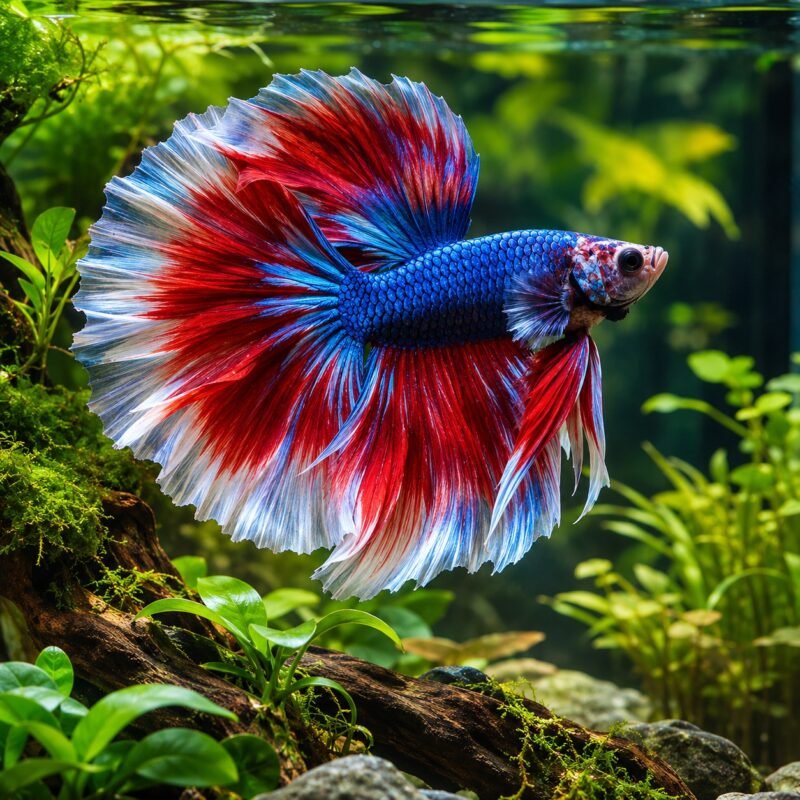
What Makes a Betta Fish a Champion? A Former Professional Judge’s Guide
What Makes a Betta Fish a Champion?
A champion betta fish is not simply the fish with the biggest fins, brightest colour, or most unusual pattern.
That is one of the first lessons a serious breeder or exhibitor needs to understand.
In a competitive betta show, judges are looking at the whole fish.
They evaluate structure, proportion, finnage, symmetry, colour, pattern, condition and how well the fish fits the standard for its class.
A fish can be spectacular at first glance and still lose to another fish that appears less dramatic.
Why?
Because show quality is about balance, not just beauty.
The current International Betta Congress (IBC) Exhibition Standards describe standards as ideals that breeders should strive toward. Fish are judged according to how closely they approach those ideals, rather than simply being judged by personal preference. The IBC states that its standards are updated annually.
That principle gives us a useful starting point:
A champion betta is a fish that combines exceptional qualities while minimizing significant faults—and does so in a way that best fits the standard for its class.
This guide explains how an experienced judge looks at a show betta and what breeders should learn from that process.
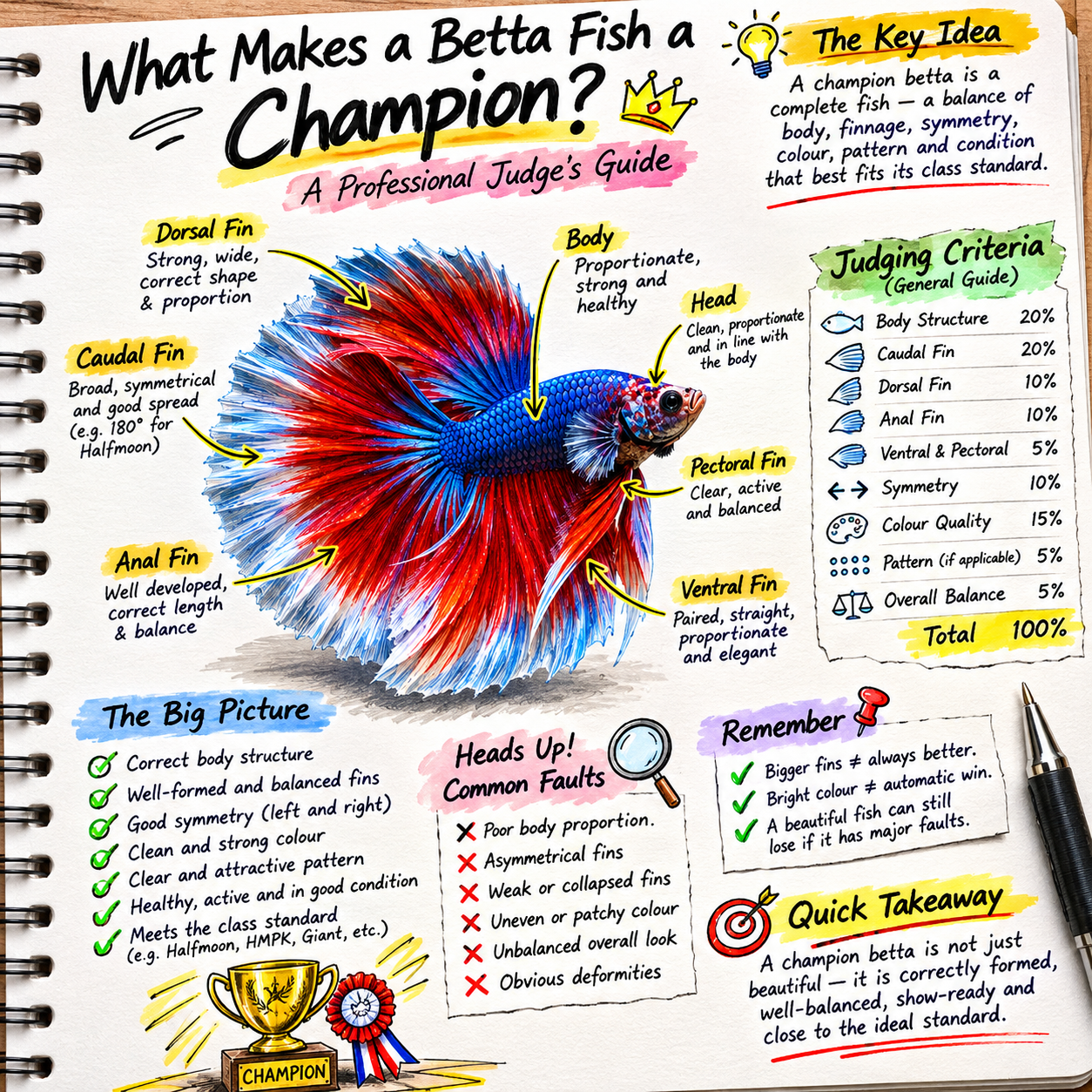
Important Disclaimer: An Educational Guide, Not an Official Judging Standard
This article is written by Betta4U for educational and general informational purposes. Its purpose is to help betta enthusiasts, beginners, breeders and hobbyists understand the physical characteristics and qualities commonly associated with a high-quality show betta.
This guide is NOT an official judging system, scoring system or exhibition standard established by the International Betta Congress (IBC) or any other betta organization, association or competition body.
The explanations, evaluation criteria and examples presented here reflect general concepts of betta fish quality and are intended to help readers develop a better understanding of body structure, finnage, symmetry, colour, pattern, proportion and overall appearance.
Different organizations, competitions and judging systems may have their own standards, classifications, judging procedures and evaluation criteria. Therefore, readers participating in official competitions should always refer to the specific rules and standards established by the respective organizing body.
Any scoring examples or percentage distributions used in this article are purely illustrative educational examples and must not be interpreted as official judging weights.
Our objective is simple: to help the public learn to recognize and appreciate a well-developed, healthy and high-quality betta fish—not to replace any established judging authority or official competition standard.
Betta4U promotes responsible betta keeping, continuous learning and the appreciation of quality betta breeding.
1. A Champion Betta Starts With the Right Foundation
Before examining the fins or colour, an experienced judge looks at the fish as a whole.
Does the fish have good overall structure?
Does the body appear healthy and proportionate?
Does the finnage complement the body?
Does anything immediately appear structurally incorrect?
This is important because spectacular finnage cannot completely hide a poor foundation.
Think of a champion betta like a building.
The colour and finnage may be the decoration, but the body and overall structure are the foundation.
If the foundation is weak, adding more decoration does not necessarily create a better fish.
The first questions a judge should ask are:
- Is the fish healthy and active?
- Is the body proportionate?
- Is the finnage appropriate for the class?
- Is the fish symmetrical?
- Are there obvious structural faults?
- Does the fish match the expected form?
- Does the colour meet the requirements of its class?
- Is the overall presentation balanced?
Only after these fundamentals are understood should the finer details receive attention.
2. Body Shape: The Foundation of a Show Betta
One of the biggest mistakes beginners make is looking at the fins before looking at the body.
Experienced breeders know better.
A betta with enormous fins but a weak or poorly proportioned body may not be competitive against a fish with superior overall structure.
The body should provide an appropriate foundation for the variety being judged.
A judge may consider:
- body proportion
- body shape
- straightness
- symmetry
- structural consistency
- relationship between body and finnage
- visible deformities
- overall balance
The exact ideal varies depending on the form and class.
A Halfmoon, HMPK, Crowntail and Giant, for example, should not simply be judged as though they are identical fish with different fins.
The class matters.
That is why knowing the standard for the specific variety is essential.
3. Finnage: Bigger Does Not Automatically Mean Better
This is probably the most misunderstood part of betta judging.
Many beginners see a huge caudal fin and immediately think:
“That must be the champion.”
Not necessarily.
A judge is interested in quality, not simply size.
A fin can be large but poorly shaped.
It can have impressive spread but poor symmetry.
It can have strong rays but an unbalanced relationship with the rest of the fish.
It can look spectacular from one angle but reveal significant structural weaknesses from another.
A judge may consider:
- fin shape
- fin symmetry
- ray structure
- branching
- proportion
- balance
- edges
- overlaps
- deformities
- relationship between the different fins
This is why professional judging requires more than looking at a photograph for a few seconds.
The fish needs to be observed.
4. The Caudal Fin: The Most Obvious Feature Isn’t Always the Most Important
For many show bettas, the caudal fin immediately attracts attention.
In a Halfmoon, for example, the ideal form involves a broad, symmetrical caudal presentation.
But the caudal should not be judged in isolation.
A beautiful caudal connected to a weak dorsal, poor anal structure or unbalanced body does not automatically create a champion.
An experienced judge looks at how the caudal works with the entire fish.
Look for:
Symmetry
Does the upper and lower portion of the caudal create a balanced appearance?
Ray structure
Are the rays strong and appropriately branched?
Edge quality
Are the edges clean and structurally appropriate?
Spread
Does the fish achieve the expected spread for its variety?
Balance
Does the caudal look proportionate to the body and other fins?
The goal is not simply:
“How big is the tail?”
The better question is:
“How good is the tail?”
5. The Dorsal Fin Can Separate a Good Fish From an Exceptional One
The dorsal fin is frequently overlooked by beginners.
Experienced judges do not overlook it.
A strong dorsal can dramatically improve the visual balance of a show betta.
Depending on the class, judges may consider:
- width
- shape
- ray development
- symmetry
- positioning
- relationship to the caudal
- relationship to the body
A fish with a spectacular caudal but a weak dorsal may appear visually unbalanced.
Conversely, a strong dorsal can help create the impression of a much more complete fish.
6. The Anal Fin: Another Critical Component of Balance
The anal fin can significantly affect the overall silhouette.
A common mistake is to look at each fin independently.
Professional judging requires looking at how all the fins work together.
The anal fin should contribute to the overall structure rather than making the fish appear disproportionately heavy on one side.
A judge may examine:
- length
- shape
- alignment
- symmetry
- ray structure
- relationship with the caudal
- overall proportion
Again, the exact expectations depend on the variety.
7. Pectoral and Ventral Fins Matter Too
Small features can become important when competition is extremely close.
Pectoral fins contribute to movement and visual balance.
Ventral fins also contribute to the overall appearance of the fish.
In a highly competitive class, small imperfections that might be ignored by a beginner can become meaningful when comparing two otherwise exceptional fish.
This illustrates an important principle:
The closer the competition, the more important the details become.
8. Symmetry: One of the Hidden Qualities of a Champion
Symmetry is one of the qualities that separates “beautiful” from “exceptional.”
A fish may have enormous fins, but if the two sides do not visually balance, the overall impression can be weaker.
Symmetry can be considered across several areas:
- caudal
- dorsal
- anal
- body
- fin alignment
- overall silhouette
- colour distribution where applicable
This is why an experienced judge often moves beyond the initial impression.
The first impression tells you:
“This fish is impressive.”
Detailed examination tells you:
“This fish is structurally excellent.”
Those are not always the same thing.
9. Colour Quality Is More Than “Bright”
Colour is another area where beginners often simplify judging.
They see:
red = good
blue = good
bright = good
But professional colour evaluation is much more complicated.
Depending on the class, judges may examine:
- colour uniformity
- density
- intensity
- distribution
- unwanted colours
- contrast
- pattern definition
- consistency with the class standard
The IBC’s exhibition material, for example, distinguishes different colour and pattern groups and provides specific criteria for evaluating them. Its standards emphasize that colour evaluation can involve subjective assessment of shades and characteristics within a defined class.
This is why two red bettas can look completely different in quality.
One may have:
- excellent density
- clean colour
- good coverage
- strong consistency
while another may show:
- uneven colour
- unwanted patches
- weak density
- inconsistent coverage
Both are “red.”
They are not necessarily equal as show fish.
10. Pattern Quality Can Make or Break a Fish
Modern bettas can display extraordinarily complex patterns.
Marble, Koi, Fancy, Galaxy, Butterfly, Dragon and other pattern types can create visually spectacular fish.
But spectacular does not automatically mean correct.
A judge must understand what the particular class requires.
For patterned fish, factors can include:
- pattern clarity
- distribution
- contrast
- balance
- colour boundaries
- unwanted colour
- consistency with the class
- overall visual harmony
This is one reason professional judging cannot simply be reduced to:
“Which fish looks prettier?”
Beauty is subjective.
Standards provide structure.
11. The Difference Between “Beautiful” and “Show Quality”
This is perhaps the most important concept for beginners.
A beautiful betta can be:
- visually striking
- unusual
- colourful
- dramatic
- photogenic
But a show-quality betta must also satisfy the requirements of its class.
Consider two fish.
Fish A
- enormous fins
- spectacular colour
- unusual pattern
- weak body
- poor symmetry
Fish B
- slightly smaller fins
- excellent body
- strong symmetry
- correct colour
- balanced finnage
- fewer significant faults
A beginner may choose Fish A.
An experienced judge may place Fish B higher.
That does not mean Fish A is ugly.
It means show judging is not simply a beauty contest.
12. Faults Matter
A champion is not a fish without any imperfection.
In reality, finding a completely perfect betta is extraordinarily difficult.
The IBC itself describes exhibition standards as ideals and goals rather than suggesting that every fish will perfectly match them.
Therefore, judges must compare strengths and weaknesses.
A fish may have:
- excellent form
- very good colour
- minor fin weakness
Another may have:
- excellent colour
- slightly weaker form
- superior symmetry
The judge must determine which fish more closely approaches the standard for that class.
This is where experience becomes extremely important.
13. Not All Faults Are Equal
This is another concept that separates professional judging from casual fish evaluation.
A tiny imperfection should not necessarily carry the same significance as a major structural fault.
For example, depending on the class and applicable standard, there may be a meaningful difference between:
- a minor colour imperfection
- a structural defect
- poor symmetry
- incorrect finnage
- a major deviation from the class standard
The current IBC judging framework contains detailed standards and judging guidance precisely because competitive evaluation requires more than a simple “good/bad” decision.
14. Overall Balance: The Champion Factor
Now we reach the quality that is difficult to teach from a photograph:
Balance.
Imagine a fish with:
- excellent body
- huge caudal
- weak dorsal
- oversized anal fin
- poor ventrals
Every individual feature may look impressive.
But put them together and the fish may look unbalanced.
Another fish may have slightly less dramatic individual features but everything works together.
That fish can create a much stronger overall impression.
This is what experienced judges often develop over years of observation:
The ability to see the fish as one complete structure rather than as a collection of separate parts.
15. Condition and Presentation Still Matter
A competition fish must be presented properly.
Condition can affect how accurately the judge can evaluate the fish.
The fish should be:
- healthy
- active
- properly conditioned
- appropriately displayed
- free from obvious disease
- presented according to show requirements
But there is an important distinction:
Presentation should reveal quality—not manufacture quality.
The IBC’s showing ethics state that exhibited bettas should remain in their natural, originally bred condition and specifically prohibit fin trimming and other alterations. The organization also emphasizes humane treatment and fair competition.
That principle is important for the credibility of competitive breeding.
16. A Champion Must Be Judged Against the Correct Standard
One of the most common mistakes online is comparing fish without considering their class.
A Giant should not be evaluated exactly like a Halfmoon.
A Crowntail should not be judged like an HMPK.
A colour variation should not automatically be evaluated using the criteria for a solid colour class.
The standard provides the framework.
The current IBC standards separate domesticated show bettas from wild-type bettas and provide class-specific exhibition guidance.
This is why a serious competitor should know:
What class am I entering?
before asking:
Is my fish good enough?
17. Why Judges Need Experience
Reading a standard is not the same as learning to judge.
A written standard can describe an ideal.
But judges still have to interpret real fish.
That requires experience.
The IBC maintains a certified judge system and an apprentice pathway. Its current judging information emphasizes continued development of proficiency, knowledge of the standards, fairness, impartiality and teaching.
That makes sense.
A judge may need to compare several fish where:
- all have excellent colour
- all have strong finnage
- all are healthy
- all are close to the standard
At that level, tiny structural differences become important.
Experience develops the ability to recognize those differences consistently.
18. What Should a Breeder Look for Before Entering a Show?
Before entering a fish, don’t simply ask:
“Is this my prettiest fish?”
Ask these questions instead.
Body
- Is the body well proportioned?
- Is the structure sound?
- Are there obvious deformities?
Finnage
- Are the fins appropriate for the class?
- Is the structure strong?
- Is the fish symmetrical?
- Are there obvious weaknesses?
Colour
- Is the colour appropriate for the class?
- Is coverage consistent?
- Are unwanted colours visible?
Pattern
- Is the pattern appropriate?
- Is it balanced?
- Is the contrast strong?
- Are there significant irregularities?
Overall
- Does the fish look balanced?
- Does one feature overwhelm the rest?
- Does the fish approach the class ideal?
This checklist alone can prevent many disappointing show entries.
19. The “Best Fish in My Fish Room” Is Not Necessarily the Best Show Fish
This is a painful lesson for breeders.
You may have 100 fish and fall in love with one particular fish.
Perhaps it has:
- amazing colour
- incredible personality
- beautiful movement
- sentimental value
- a rare pattern
But sentimental value has nothing to do with judging.
A breeder must learn to separate:
“I love this fish.”
from:
“This fish is competitive.”
The strongest breeders can do this.
They can admire a fish while honestly identifying its weaknesses.
That objectivity is a major part of becoming a better breeder.
20. Champion Fish Are Usually the Result of Selection, Not Luck
A champion rarely appears by accident.
Behind one exceptional fish may be:
- generations of selective breeding
- careful pairing
- culling
- record keeping
- water management
- nutrition
- conditioning
- genetic planning
- patience
The trophy is therefore not simply a reward for the fish.
It is recognition of the breeder’s work.
This is why experienced breeders should study why a fish wins rather than simply trying to copy its appearance.
Ask:
What genetic traits produced this fish?
Which parents contributed the strongest characteristics?
Which weaknesses need to be improved in the next generation?
Is this fish better for showing, breeding, or both?
Those questions lead to long-term progress.
21. The Champion Fish vs the Champion Breeding Fish
Here is an important distinction.
A champion show fish is not automatically the perfect breeding fish.
A breeding fish may possess an extremely valuable trait while carrying a visible weakness.
For example, a breeder might retain a fish because it carries exceptional:
- caudal structure
- colour intensity
- pattern
- body form
- branching
even though the fish itself is not the best show specimen.
Why?
Because breeding is about genetic potential, not just appearance.
The best breeders therefore learn to evaluate fish in two different ways:
Show evaluation
How good is this fish today?
Breeding evaluation
What can this fish contribute to the next generation?
Those are different questions.
22. How to Improve Your Eye for Betta Judging
You do not need to become an official judge to develop a better judging eye.
Start by comparing fish systematically.
Take two fish of the same variety.
Instead of asking:
“Which one do I like?”
write down:
| Category | Fish A | Fish B |
|---|---|---|
| Body | ||
| Caudal | ||
| Dorsal | ||
| Anal | ||
| Pectorals | ||
| Symmetry | ||
| Colour | ||
| Pattern | ||
| Balance | ||
| Overall |
Then explain why you gave each assessment.
This exercise trains your eye.
Even better, compare your assessment with experienced judges or published show results.
Over time, you begin to recognize details that were invisible to you as a beginner.
23. The Future of Betta Judging
Betta judging is entering an interesting period.
The hobby is becoming increasingly global and digital.
Fish are being shared through social media before they ever reach a physical show.
International competitions are becoming more visible.
Breeders from Asia, Europe, the Americas and other regions can communicate instantly.
This creates an opportunity for judging systems to become more transparent and educational.
Imagine future competitions where each champion receives:
- professional photographs
- judge commentary
- detailed scoring
- fault analysis
- breeder information
- breeding notes
- historical results
That would turn a competition into an educational resource.
The goal should not be simply to identify a winner.
The goal should be to help the entire community understand why the winner won.
24. What Really Makes a Betta a Champion?
If we reduce everything in this article to one concept, it is this:
A champion betta is a complete fish.
Not merely a fish with huge fins.
Not merely a fish with incredible colour.
Not merely a fish with an unusual pattern.
Not merely a fish that photographs well.
A champion combines:
Structure + Finnage + Symmetry + Colour + Pattern + Balance + Condition + Standard Compliance
And when those qualities come together, something special happens.
The fish looks complete.
That is what experienced breeders and judges learn to recognize.
Final Thoughts: Learn to See the Fish, Not Just the Fins
The most important step in becoming a better betta breeder is learning how to look beyond first impressions.
When you see an incredible Halfmoon, don’t immediately ask:
“How big is the tail?”
Ask:
“Is the entire fish balanced?”
When you see a spectacular Koi, don’t only ask:
“How beautiful is the pattern?”
Ask:
“How well does the pattern meet the requirements of its class?”
When you see a champion, don’t simply ask:
“Why did this fish win?”
Ask:
“What did the judges see that I have not yet learned to see?”
That question is the beginning of expertise.
The current IBC standards are intended as ideals for developing show bettas, while its judge program emphasizes continued proficiency, knowledge of the standards, fairness and teaching.
For breeders, this is the real lesson:
Don’t breed simply to produce a beautiful betta. Breed toward a better betta.
And don’t judge simply by what catches your eye.
Learn to understand why it catches your eye—and whether the structure underneath that beauty deserves a champion’s place.
Frequently Asked Questions About Champion Betta Fish
What makes a betta fish a champion?
A champion betta combines excellent body structure, finnage, symmetry, colour, pattern and overall balance while closely matching the standard for its competition class.
What is a show-quality betta?
A show-quality betta is a fish whose physical characteristics closely approach the ideal described for its particular show class. It is not simply a colourful or expensive betta.
Are bigger fins better in betta competitions?
Not necessarily. Finnage is evaluated for qualities such as shape, structure, symmetry, proportion and balance rather than size alone.
Does colour matter more than body shape?
Neither should automatically be considered in isolation. Judges evaluate multiple characteristics according to the requirements of the particular class. A spectacular colour cannot automatically compensate for every structural weakness.
What is the most important part of a show betta?
There is no single feature that makes every champion. The overall combination of structure, finnage, symmetry, colour, pattern and balance is what creates a strong competitive fish.
Can a beautiful betta lose a competition?
Yes. A fish can be extremely attractive but have structural or class-specific faults that reduce its competitiveness against another fish that more closely approaches the applicable standard.
Is a champion show betta always a good breeding fish?
Not necessarily. Show quality describes the fish’s current phenotype, while breeding quality also involves genetic potential and the traits the fish can contribute to future generations.
Can beginners learn to judge betta fish?
Absolutely. Beginners can develop their judging eye by studying standards, comparing fish systematically, learning terminology and discussing fish with experienced breeders and judges.
Are betta fish allowed to be trimmed for shows?
Under the IBC’s showing ethics, exhibited bettas are expected to remain in their natural, originally bred condition, and fin trimming or other alterations are not permitted.
Where can I learn the official IBC betta standards?
The official IBC Exhibition Standards are publicly available and are updated for each show season.
Betta4U Expert Takeaway
When evaluating your next betta, remember the 8-point Champion Checklist:
1. Body — Is the foundation correct?
2. Finnage — Are the fins structurally strong?
3. Symmetry — Does the fish balance from side to side?
4. Colour — Is the colour clean, appropriate and consistent?
5. Pattern — Does the pattern meet the class requirements?
6. Proportion — Do the body and fins work together?
7. Condition — Is the fish healthy and properly presented?
8. Overall Balance — Does the entire fish look complete?
If the answer to all eight is strong, you may have something special.
If several are weak, the fish may still be beautiful—but it is probably telling you exactly what your breeding program needs to improve next.
That is how a breeder learns to see a champion before the trophy is ever awarded.
About Betta4U
Betta4U is dedicated to helping betta keepers and breeders improve their knowledge of betta care, water quality, breeding, nutrition, health, show standards and competition.
Our goal is not simply to help you keep bettas alive.
It is to help you understand what makes a betta healthy, beautiful, structurally correct and genuinely exceptional.
Recommended Related Articles
- The Professional Guide to Judging HMPK Betta Fish
- Halfmoon Betta Standards: What Judges Really Look For
- Show Quality vs Pet Quality Betta: What’s the Difference?
- Why Some Beautiful Betta Fish Should Never Win a Show
- How to Choose a Betta Fish for Breeding
- Betta Judge’s Eye: Finding Hidden Faults in a Champion Fish
- IBC vs Thai Betta Standards: Understanding Different Judging Systems
Primary Authority Reference
For the official exhibition framework, consult the International Betta Congress Standards and its published judging resources. The IBC states that its standards establish ideals for betta form and colour and are updated annually.