
Oct
MAA Blog, Aquatic Life Care, Aquatic Science and Research
Understand Betta4U Pati Ketapang Peraman (PKP): A Complete Guide for Fish Keepers
Pati Ketapang Peraman (PKP) is a ketapang leaf preparation designed for aquarium keepers who want to incorporate the traditional use of Indian almond leaves into their fish-care routine. However, understanding what PKP is, how to use it responsibly, and how its freshness changes over time is important before adding it to your aquarium.
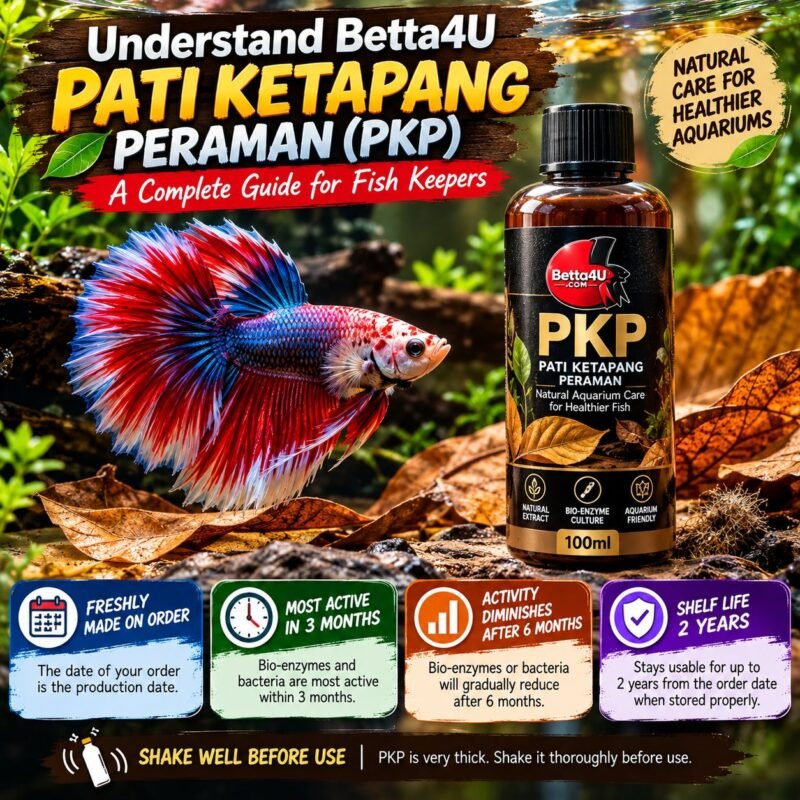
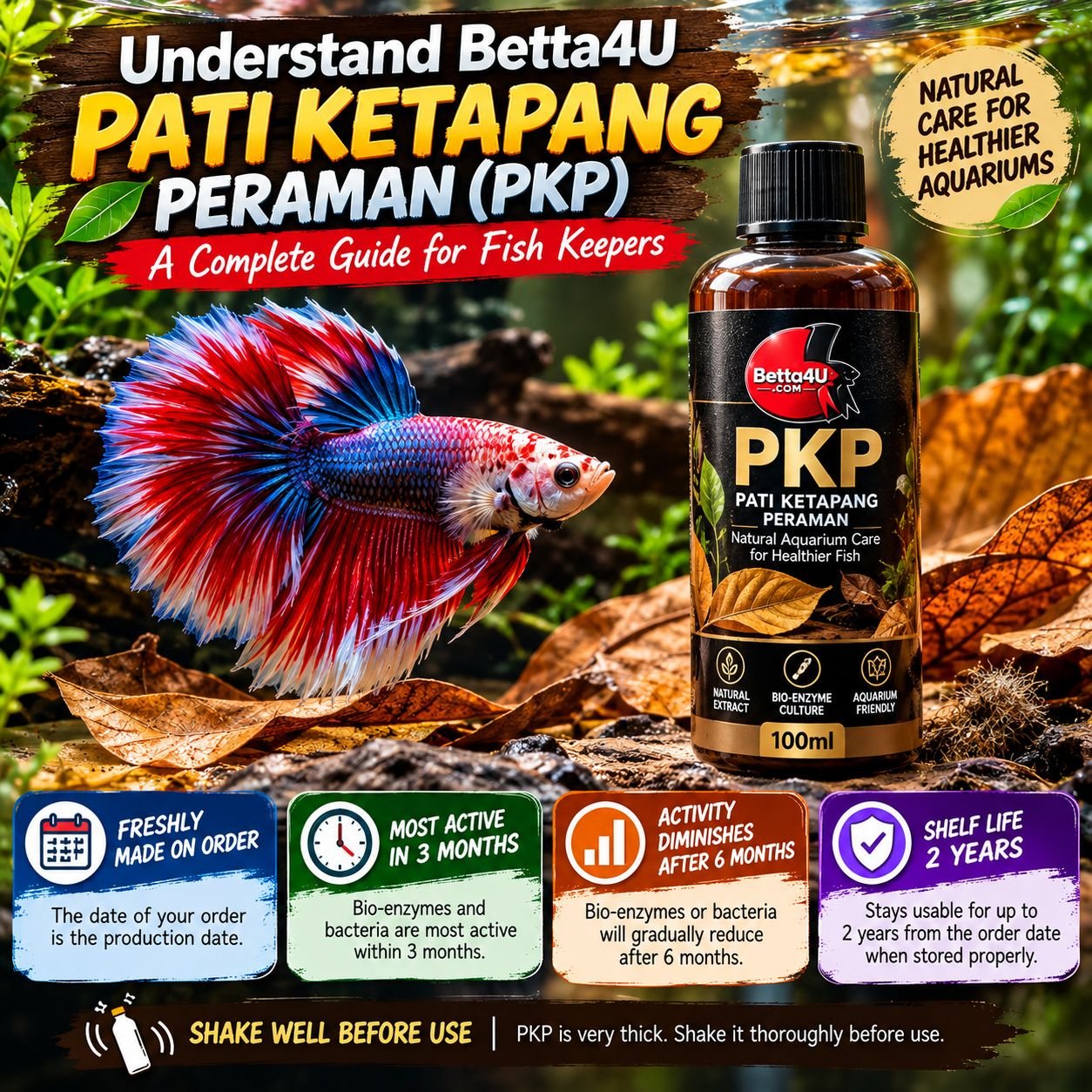
Betta4U Pati Ketapang Peraman is made using ketapang leaf material associated with the Indian almond tree (Terminalia catappa). The preparation is thick, so it should be shaken thoroughly before use. Betta4U also follows a specific date policy: the order date is the production date, the stated shelf life is two years, and the biological activity associated with the preparation is expected to be strongest during the first three months.
This guide explains the product, the science behind ketapang leaves, practical aquarium considerations, and how to understand the difference between the product’s shelf life and its period of greatest biological activity.
Important: PKP is an aquarium-care product, not a guaranteed cure for fish diseases. Good water quality, appropriate nutrition, careful observation and suitable treatment when necessary remain essential to responsible fish keeping.
Table of Contents
- What Is Betta4U Pati Ketapang Peraman?
- What Is Ketapang and Why Do Fish Keepers Use It?
- Understanding PKP’s Production Date and Shelf Life
- Why Is PKP So Thick?
- Potential Uses and Benefits of Ketapang Preparations
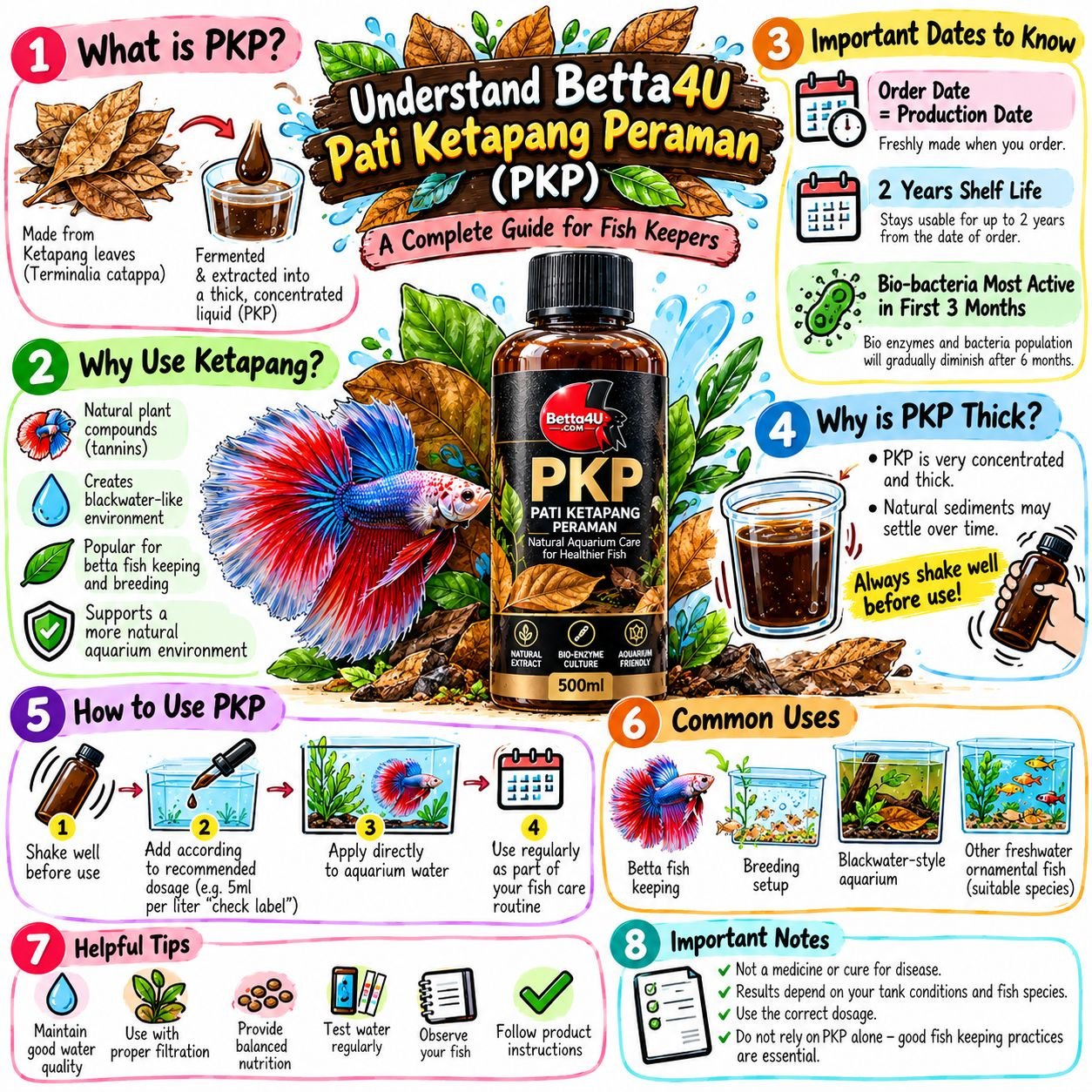
- How to Use PKP Responsibly
- Common Problems and Mistakes
- Best Practices for Betta Fish Keepers
- Common Myths About PKP
- Frequently Asked Questions
- Related Betta4U Products
- Conclusion
What Is Betta4U Pati Ketapang Peraman?
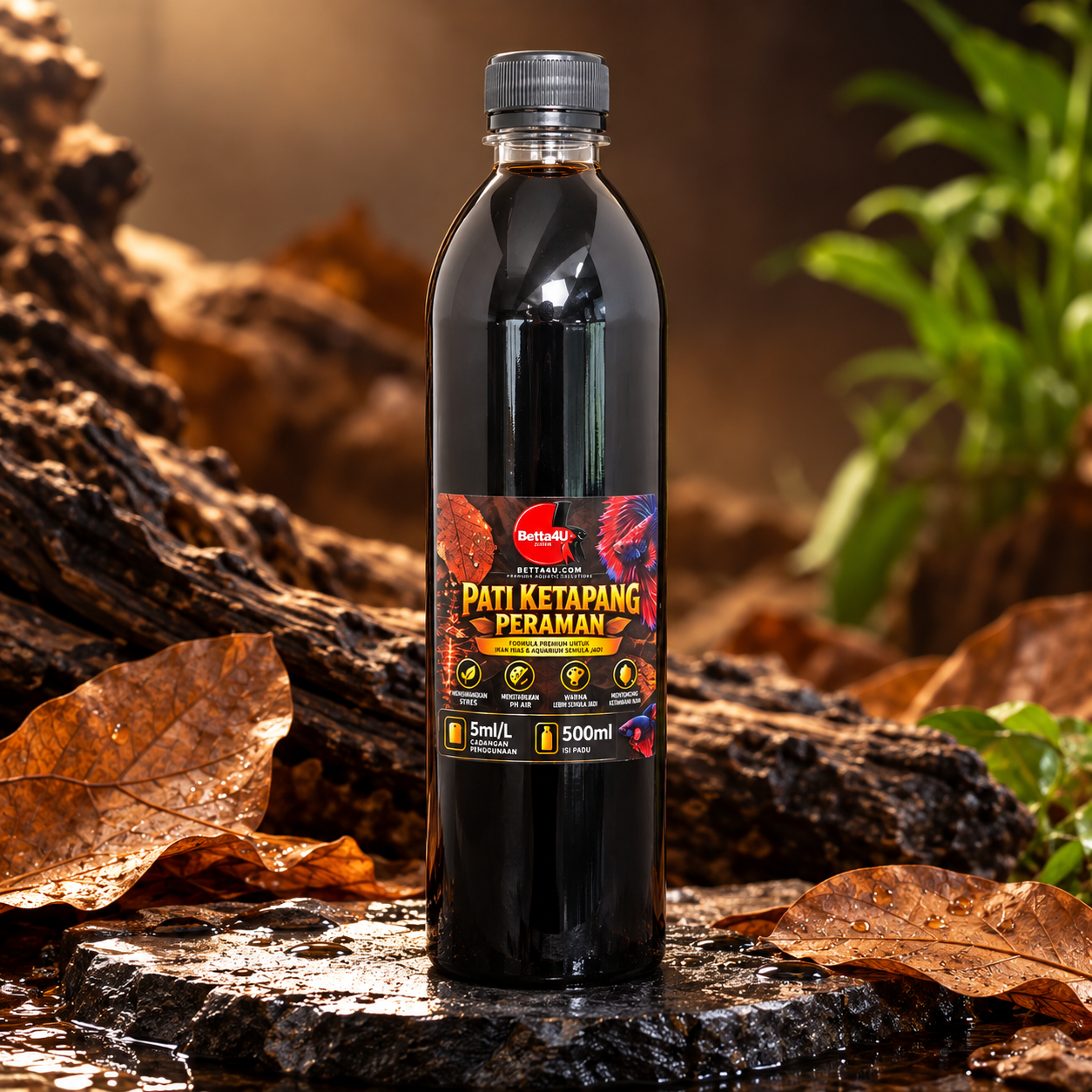
Betta4U Pati Ketapang Peraman, commonly known as PKP, is a thick ketapang-based preparation for aquarium use. Ketapang is the Malay name commonly used for the Indian almond tree, Terminalia catappa.
Fish keepers have traditionally used Indian almond leaves in freshwater aquariums, especially betta setups. These leaves contain naturally occurring plant compounds, including tannins and other polyphenols, that can leach into the water.
PKP offers an alternative to adding whole dried leaves. Instead of placing leaves directly into an aquarium, keepers can use a prepared liquid product according to its label instructions.
Who may find PKP useful?
PKP may interest:
- Betta fish hobbyists who use ketapang preparations in their regular aquarium routines.
- Betta breeders managing multiple tanks.
- Ornamental fish keepers interested in traditional blackwater-style setups.
- Aquarists who prefer a prepared product instead of processing dried leaves themselves.
The suitability of PKP depends on the fish species, aquarium conditions, product instructions and the purpose for which it is being used.
Product information: Visit the Betta4U Pati Ketapang Peraman product page.
What Is Ketapang and Why Do Fish Keepers Use It?
Ketapang (Terminalia catappa) is a tropical tree whose leaves have been used in traditional aquarium practices. When suitable dried leaves are immersed in water, they release soluble plant compounds that can gradually change the water’s colour and chemistry.
This creates what aquarists commonly call blackwater: water containing dissolved organic compounds that give it a yellowish, tea-like or brown appearance.
However, blackwater is not a single, precisely defined water condition. Two aquariums can look similarly brown while having different pH, hardness, dissolved organic matter and microbial characteristics.
What are tannins?
Tannins are a group of naturally occurring plant compounds. In an aquarium, tannin-containing preparations may:
- Add a yellow, amber or brown tint to the water.
- Contribute dissolved organic compounds.
- Influence water chemistry, depending on the product and the aquarium’s buffering capacity.
The degree of change varies with the concentration of the preparation, the aquarium’s existing water chemistry and the amount added.
A darker colour does not automatically mean that the water is healthier. Likewise, clear water is not necessarily free from ammonia, nitrite or other water-quality problems.
What does research say about ketapang?
Research has investigated extracts of Terminalia catappa for their chemical composition and potential biological effects. Some laboratory studies have reported antibacterial activity for particular extracts under controlled conditions.
However, laboratory results do not automatically establish the effectiveness, safe dosage or disease-treatment ability of every commercially prepared ketapang product.
For example, a 2026 study indexed by PubMed examined different Terminalia catappa extracts in laboratory antibacterial tests. Its findings were preliminary and the authors noted that further research, including testing in living systems, was needed.
Therefore, it is more responsible to describe PKP as a ketapang-based aquarium preparation than to claim that it cures infections or guarantees healthier fish.
Understanding PKP’s Production Date and Shelf Life
One of the most important things customers should understand about Betta4U Pati Ketapang Peraman is its date policy.
PKP is prepared on a small-scale, made-to-order basis. The date of the customer’s order is treated as the product’s production date. The product’s stated shelf life is two years from that date, while its associated biological activity follows a shorter timeline.
PKP freshness timeline
| Time from order date | Betta4U product guidance |
|---|---|
| Day of order | The order date is the production date. |
| First 3 months | The associated bio-bacteria population is expected to be most active. |
| Up to approximately 6 months | Biological activity may diminish over time. |
| Up to 2 years | The stated shelf-life period, subject to appropriate storage and the product’s condition. |
These timeframes describe different things. They should not be treated as interchangeable.
Why are biological activity and shelf life different?
A product’s shelf life refers to the period during which it is intended to remain suitable for use under the specified storage conditions.
Biological activity, however, can change over time. If a preparation contains living microorganisms or biologically active components, their activity may decline depending on temperature, oxygen exposure, pH, contamination and other factors.
Consequently, a product may still be within its stated shelf-life period even though its biological activity is lower than it was when freshly prepared.
Important clarification: The three-month and six-month biological timeframes are Betta4U’s stated product guidance. Without product-specific laboratory testing, the actual bacterial population, enzyme activity and rate of decline cannot be quantified precisely.
How should customers interpret the two-year period?
The two-year period is the stated shelf life, not a guarantee that every biological component will remain equally active throughout those two years.
Customers should check the order date, store the product appropriately and inspect it before use. If the bottle develops an unexpected smell, visible contamination, unusual gas pressure or another unexplained change, do not assume it remains suitable simply because it is within the stated period. Contact Betta4U for advice.
Why Is PKP So Thick?
Betta4U PKP has a thick consistency. This is an important practical characteristic because the contents may not be evenly distributed throughout the bottle after standing.
Always shake the bottle thoroughly before use.
Shaking helps redistribute the contents so that the portion you dispense is more representative of the mixture. Without shaking, thicker material may settle or become unevenly distributed.
Does thickness mean the product is better?
Not necessarily.
Thickness alone does not prove the concentration of tannins, the number of beneficial bacteria, the level of enzyme activity or the effectiveness of a product.
Different preparations can have different consistencies because of their composition and manufacturing methods. Product performance should be assessed using reliable formulation information, appropriate instructions and relevant testing—not appearance alone.
How should you handle a thick preparation?
- Check that the bottle is properly sealed and appears normal.
- Shake it thoroughly before dispensing.
- Follow the dosage instructions supplied for your specific product.
- Avoid estimating a dose by eye if accurate measurement is required.
- Close the cap securely after use.
Do not dilute the entire bottle unless the product instructions specifically recommend doing so. Preparing a diluted stock solution may alter its storage characteristics and contamination risk.
Potential Uses and Benefits of Ketapang Preparations
Ketapang preparations are popular among betta keepers because they provide a convenient way to introduce compounds associated with Indian almond leaves.
Nevertheless, potential uses should be distinguished from proven product-specific effects.
1. Supporting a blackwater-style aquarium
Some aquarists prefer amber-coloured water because it resembles conditions found in certain natural habitats.
PKP may be used as part of a blackwater-style setup when appropriate for the fish being kept. However, water colour should not be the only measure of whether the aquarium is suitable.
Monitor pH and other relevant water parameters, especially when keeping fish that require stable conditions.
2. Incorporating ketapang into routine fish care
For keepers who already use ketapang leaves, a prepared extract may offer a convenient alternative to handling whole leaves.
Follow the product’s instructions and consider the aquarium’s volume, existing water chemistry and the sensitivity of the fish.
3. Exploring traditional betta-keeping practices
Many betta keepers associate ketapang with traditional blackwater husbandry. However, practices that are popular among hobbyists are not automatically supported by strong scientific evidence.
A responsible approach is to observe the fish, maintain good husbandry and avoid assuming that every benefit attributed to ketapang has been demonstrated for every preparation.
What PKP should not replace
PKP should not replace:
- Regular water testing.
- Suitable filtration and adequate oxygenation.
- Appropriate feeding.
- Routine aquarium maintenance.
- Quarantine and observation of newly acquired fish.
- Veterinary or qualified aquatic-animal advice when disease is suspected.
For guidance on fish environments and water quality, consult the Merck Veterinary Manual’s fish-care guidance.
How to Use PKP Responsibly
Because the correct dosage depends on the specific product formulation and its instructions, always use the dosage stated on your PKP label or confirmed by Betta4U.
Do not calculate a dose from the product’s thickness, colour or age alone.
Step 1: Check your aquarium
Before adding PKP, check the aquarium’s general condition.
Consider:
- Aquarium water volume.
- Fish species and current condition.
- Existing water colour and chemistry.
- Whether the aquarium contains delicate livestock.
- Whether other treatments or additives are already in use.
If the fish are showing signs of distress, test the water rather than assuming that a ketapang preparation is the solution.
Step 2: Check the product date
Use the order date as the production date under Betta4U’s stated policy.
If you are choosing between older and newer stock specifically for the product’s associated biological activity, remember that Betta4U considers the first three months the period of greatest activity.
Step 3: Shake the bottle thoroughly
PKP is thick, so shake it before dispensing.
This step is particularly important when the bottle has been standing for a period of time.
Step 4: Measure the recommended dosage
Use the dosage stated on the current product label or confirmed by Betta4U.
Avoid adding extra product in the hope of obtaining faster or stronger results. A higher concentration may change water chemistry more than intended, and more is not necessarily better.
Step 5: Introduce the product carefully
Add PKP according to the label instructions.
If you are using it for the first time, monitor the aquarium after application. Check the fish’s behaviour and water parameters where appropriate.
Do not combine multiple water treatments without checking their compatibility.
Step 6: Continue routine maintenance
Keep up with water testing, suitable feeding, filtration and regular water changes.
For a new aquarium, do not rely on PKP to establish the biological filter. The filter needs an appropriate population of nitrifying microorganisms to process fish waste.
The Merck Veterinary Manual’s aquarium fish management guidance explains the importance of monitoring aquarium conditions and managing problems associated with ammonia and nitrite.
Common Problems and Mistakes
Adding too much product
Adding more than the recommended dosage can cause unnecessary changes in water chemistry. It may also make it harder to identify the cause if fish begin behaving unusually.
What to do: Follow the label and monitor the aquarium rather than increasing the dose based on appearance alone.
Assuming darker water means better water
Dark amber water may be desirable for some setups, but colour does not establish that ammonia and nitrite are safe.
What to do: Use appropriate water tests and maintain the aquarium according to the needs of the fish.
Using old PKP without considering biological activity
A bottle can be within its stated two-year shelf-life period while its biological activity has declined.
What to do: Consider the order date and the purpose for which you are using the product. If maximum biological activity is important, follow Betta4U’s guidance regarding the first three months.
Forgetting to shake the bottle
Because PKP is thick, its contents may not remain evenly distributed after standing.
What to do: Shake thoroughly before each use.
Treating disease without identifying the cause
Lethargy, fin deterioration, loss of appetite and unusual swimming can result from several different problems, including poor water quality, injury, parasites or infection.
What to do: Check water quality first, observe the symptoms carefully and seek qualified advice when needed. Do not rely on PKP as a substitute for appropriate diagnosis or treatment.
Signs and Symptoms to Monitor in Your Fish
After introducing any new aquarium additive, observe your fish for changes.
Watch for:
- Unusual lethargy or reduced activity.
- Loss of appetite.
- Rapid breathing or gasping at the surface.
- Clamped fins or unusual swimming.
- Sudden changes in behaviour.
- Signs of irritation or distress.
These signs are not specific to PKP exposure and do not prove that the product caused a problem. They can indicate water-quality issues or other health concerns.
If several fish become distressed soon after an additive is introduced, stop adding the product, check the water parameters and consider a suitable partial water change using properly prepared water. Maintain adequate aeration and seek qualified advice if symptoms persist.
Do not add additional chemicals in an attempt to correct the problem without understanding the cause.
Best Practices for Betta Fish Keepers
Experienced fish keepers know that stable conditions are usually more useful than repeatedly changing aquarium products.
Maintain stable water conditions
Monitor temperature, pH, ammonia and nitrite as appropriate for your setup. Ammonia and nitrite problems can harm fish even when the water looks clear.
Avoid unnecessary additives
Use products for a defined purpose. Combining multiple additives without understanding their ingredients or compatibility makes aquarium management more complicated.
Keep a simple record
For breeders and fish farms, record:
- The product name.
- The order or production date.
- The date the bottle was opened.
- The aquarium or tank where it was used.
- The amount added.
- Any relevant observations.
This helps you compare results and avoid confusion between different batches.
Store the bottle appropriately
Keep the cap tightly closed and follow the storage instructions provided for your product. Avoid leaving it exposed to direct sunlight or excessive heat if the label advises against this.
Prioritise water quality
The Food and Agriculture Organization (FAO) provides aquaculture resources that discuss water quality and fish production. Good water management remains a fundamental part of responsible fish keeping, regardless of which additives you choose.
Common Myths About PKP
| Myth | Fact |
|---|---|
| Darker water always means healthier fish. | Water colour does not prove that water quality is suitable. |
| PKP cures all bacterial infections. | Ketapang research does not establish that PKP cures fish diseases. |
| A thick product is automatically more concentrated or effective. | Thickness alone cannot establish potency or performance. |
| PKP’s biological activity remains unchanged for two years. | Betta4U states that biological activity is strongest in the first three months and diminishes over approximately six months. |
| A bottle is unusable as soon as it passes three months. | The three-month period refers to the stated period of greatest biological activity, not the full stated shelf life. |
| PKP replaces water changes. | Routine maintenance and water-quality management remain necessary. |
| Adding more PKP produces better results. | Use the recommended dosage; excess product may cause unwanted changes. |
| All fish species respond to ketapang in the same way. | Suitability depends on the species, formulation and aquarium conditions. |
Frequently Asked Questions About PKP
1. What is Betta4U Pati Ketapang Peraman?
Betta4U Pati Ketapang Peraman, or PKP, is a thick ketapang-based preparation intended for aquarium use. Ketapang is commonly known as Indian almond tree, Terminalia catappa. Its leaves contain naturally occurring plant compounds, including tannins, that can influence water colour and chemistry. PKP provides a prepared alternative to adding whole leaves. Use it according to the instructions for your product, and remember that it is not a guaranteed treatment for fish disease.
2. What is the production date of PKP?
Under Betta4U’s stated policy, the date of the customer’s order is treated as the production date. This is important because the product’s stated shelf life and biological-activity guidance are calculated from that date. Keep your order information so you can refer to the correct date when assessing the product’s age. If you are unsure about a particular bottle or batch, contact Betta4U before use.
3. What is the shelf life of Betta4U PKP?
Betta4U states a shelf life of two years from the order date. This period should not be confused with the duration of greatest biological activity. The product’s associated bio-bacteria are stated to be most active within the first three months, with biological activity diminishing over approximately six months. These timeframes describe different product characteristics. Follow the product’s storage instructions and do not use a bottle that shows signs of unexpected deterioration or contamination.
4. Why is PKP most active during the first three months?
According to Betta4U’s product guidance, the associated bio-bacteria population is most active during the first three months from the order date. Biological activity can change during storage, depending on factors such as temperature, oxygen exposure, pH and the characteristics of the formulation. However, without product-specific laboratory testing, the exact population and rate of decline cannot be confirmed. The three-month period should therefore be understood as Betta4U’s product guidance rather than a laboratory-verified measurement for every bottle.
5. Can I use PKP after three months?
The three-month period is the stated period of greatest biological activity, not the end of the product’s full stated shelf life. Betta4U gives a two-year shelf life from the order date, while noting that biological activity diminishes over approximately six months. Whether an older bottle is suitable for your intended purpose depends on its condition, storage history and the product instructions. If you specifically want the highest associated biological activity, follow Betta4U’s guidance and contact the company if you need advice about an older bottle.
6. Why must I shake PKP before use?
PKP is a thick preparation. After standing, its contents may not remain evenly distributed throughout the bottle. Shaking it thoroughly before use helps redistribute the mixture before you measure a dose. This is a simple handling step that supports more consistent dispensing. It does not, by itself, prove that the product contains a particular concentration of tannins, enzymes or bacteria. Always follow the dosage instructions supplied for the product rather than estimating an amount from its thickness or appearance.
7. Does PKP lower aquarium pH?
Ketapang preparations may influence pH, but the extent of any change depends on the preparation and the aquarium’s buffering capacity, among other factors. Do not assume that every dose will produce the same pH change in every tank. If stable pH is important for your fish, test the water before and after introducing a new additive. Avoid trying to reach a target pH by adding increasing amounts of PKP. Stable, species-appropriate conditions are generally more useful than making sudden changes to water chemistry.
8. Can PKP cure fin rot or other fish diseases?
PKP should not be regarded as a guaranteed cure for fin rot, bacterial infections, parasites or other diseases. Research on compounds found in ketapang leaves does not automatically demonstrate that a particular commercial preparation can treat a disease in living fish. Similar symptoms can also have different causes, including poor water quality, injury and infection. If a fish is unwell, check the water parameters, observe the symptoms and seek qualified aquatic-animal advice when necessary. Use an appropriate treatment when indicated rather than relying on PKP alone.
9. Can I combine PKP with other aquarium products?
Compatibility depends on the products’ formulations, ingredients and intended uses. Do not assume that two products are compatible simply because each is sold for aquarium care. Check the labels and seek advice from the manufacturers when necessary. Avoid introducing several new additives at the same time, because doing so can make it harder to identify the cause if fish react unexpectedly. Continue monitoring water quality and observe your fish after introducing any new product.
10. Where can I buy Betta4U Pati Ketapang Peraman?
You can view product information and available size options on the Betta4U Pati Ketapang Peraman product page. Check the current listing for available options, price and product instructions before ordering. Remember that the order date is treated as the production date under Betta4U’s stated policy. If you have questions about a particular bottle’s age, storage or intended use, contact Betta4U for clarification before adding it to your aquarium.
Betta4U Product Recommendations
PKP can be considered alongside other products as part of a broader aquarium-care routine. Choose products according to your actual needs rather than using everything at once.
| Product | Potential role in an aquarium-care routine |
|---|---|
| Betta4U Pati Ketapang Peraman (PKP) | A prepared ketapang-based product for keepers who use ketapang in their aquarium routine. |
| Betta4U Booster | Consider for routine supplementation according to its specific label instructions. |
| Betta4U Protection | Review the product label to determine whether it suits your intended water-care purpose. |
| Betta4U Cure | Consider only when its stated intended use is appropriate; suspected disease may require diagnosis and targeted treatment. |
| Betta4U Velvet Cure | Use only for the conditions and species specified by its label. |
| Betta4U General Aid | Check the product description and directions before adding it to your maintenance routine. |
| Betta4U Black Dust (BBD) | Review the current product information to understand its intended role and correct application. |
| Betta4U Anti Chlorine | Use an appropriate water conditioner when preparing water that contains chlorine or chloramine. |
| Betta4U PSB Live Bacteria | A separate microbial product to consider for its labelled purpose; do not assume it is interchangeable with PKP. |
| Chlorella Green Water Culture | Relevant to fish keepers who culture live food or maintain a green-water setup, according to the product instructions. |
Always check the latest product labels, dosage instructions and compatibility before combining products.
Internal Linking Recommendations
Use these links within the article where they are relevant to the reader. Confirm the exact product URLs in WooCommerce before publishing any links that have not been verified.
| Anchor text | Suggested URL |
|---|---|
| Betta4U Pati Ketapang Peraman | https://betta4u.com/product/ketapang-leaf-extract-for-healthy-fish/ |
| Betta4U PSB Live Bacteria | https://betta4u.com/product/psb-live-bacteria-freshwater-n-saltwater/ |
| Kutu Air Moina 50ml | https://betta4u.com/product/kutu-air-moina-50ml/ |
| Betta4U Booster | Verify the current WooCommerce product URL |
| Betta4U Protection | Verify the current WooCommerce product URL |
| Betta4U Cure | Verify the current WooCommerce product URL |
| Betta4U Velvet Cure | Verify the current WooCommerce product URL |
| Betta4U General Aid | Verify the current WooCommerce product URL |
| Betta4U Black Dust | Verify the current WooCommerce product URL |
| Betta4U Anti Chlorine | Verify the current WooCommerce product URL |
| Chlorella Green Water Culture | Verify the current WooCommerce product URL |
| Betta fish care guide | Link to a relevant existing Betta4U blog article, if available |
Internal-linking tip: Use descriptive anchor text naturally. Do not force every product link into the article if it does not help the reader.
External References
These authoritative resources can support the article’s general discussion of fish health, aquarium water quality and ketapang research.
| Website | Why refer to it |
|---|---|
| Merck Veterinary Manual — Providing a Home for Fish | General guidance on fish environments and the importance of suitable water quality. |
| Merck Veterinary Manual — Management of Aquarium Fish | Background on aquarium management and common water-quality problems. |
| Food and Agriculture Organization (FAO) | General aquaculture information and fish-production resources. |
| PubMed — Research on Terminalia catappa extracts | A recent study of antibacterial activity in different ketapang extracts, with limitations that should be acknowledged. |
SEO note: These links lead to independent informational resources. If your website requires particular link attributes, set them according to your editorial and SEO policy. Do not label a link “DoFollow” unless you have confirmed that its HTML does not include a nofollow, sponsored or other relevant link attribute.
Image Recommendations
Use original product photos where possible. The bottle, label and Betta4U branding should remain accurate. Avoid adding medical claims or guaranteed results to the images.
| No. | Filename | Alt text | Caption | Placement |
|---|---|---|---|---|
| 1 | betta4u-pati-ketapang-peraman-pkp.jpg | Betta4U Pati Ketapang Peraman PKP ketapang leaf preparation | Meet Betta4U Pati Ketapang Peraman, a prepared ketapang-based aquarium product. | Featured image and introduction |
| 2 | what-is-pati-ketapang-peraman-pkp.jpg | What is Betta4U Pati Ketapang Peraman PKP | Understand the role of PKP in a responsible aquarium-care routine. | What Is PKP section |
| 3 | terminalia-catappa-indian-almond-leaves.jpg | Indian almond ketapang leaves from Terminalia catappa | Ketapang leaves are traditionally used in blackwater-style aquarium setups. | Ketapang background section |
| 4 | pkp-production-date-and-shelf-life.jpg | Betta4U PKP production date and two-year stated shelf life | Understand the difference between stated shelf life and biological activity. | Shelf-life section |
| 5 | shake-thick-pati-ketapang-peraman.jpg | Shake thick Betta4U Pati Ketapang Peraman before use | Shake the thick preparation thoroughly before dispensing. | Handling section |
| 6 | responsible-pkp-aquarium-use.jpg | Responsible use of ketapang preparation in a freshwater aquarium | Follow product instructions and monitor aquarium conditions. | Step-by-step guide |
| 7 | betta-fish-water-quality-monitoring.jpg | Betta fish aquarium water quality monitoring | Water testing and routine maintenance remain essential for fish health. | Best-practices section |
| 8 | betta4u-pkp-product-guide.jpg | Betta4U Pati Ketapang Peraman PKP product guide | Learn about PKP’s handling, freshness and responsible use. | Conclusion and CTA |
Featured Image Prompt
Prompt:
Create a premium, photorealistic commercial aquarium product photograph for a professional aquatics brand. Feature a beautiful, anatomically accurate betta fish swimming naturally in a clean freshwater aquarium with subtle amber-coloured water inspired by Indian almond ketapang leaves. Include realistic aquatic plants, delicate natural leaf details and fine water particles. Use cinematic lighting, vibrant yet natural colours, high contrast, sharp focus, ultra-detailed textures, DSLR photography aesthetics, a macro lens look and premium 8K visual quality.
If a Betta4U Pati Ketapang Peraman product photograph is supplied, use it as the exact product reference. Preserve the original bottle shape, proportions, label, cap, product colour and branding. Do not invent ingredients, certification badges or product claims. Place the bottle clearly in the composition without obscuring the betta fish. Leave clean negative space for a headline to be added later. Maintain a professional, trustworthy and educational advertising style. Square 1:1 aspect ratio.
Negative prompt: No watermark, blurry details, low quality, illegible generated text, altered logo, distorted bottle, incorrect label, duplicate fish, deformed fins, cropped fish, oversaturated colours, exaggerated medical imagery, disease-treatment claims or unrealistic aquarium conditions.
Conclusion
Betta4U Pati Ketapang Peraman offers fish keepers a prepared way to incorporate ketapang into their aquarium-care routine. Understanding the product’s consistency, date policy and intended use helps customers make informed decisions.
Remember three important points: the order date is the production date, the stated shelf life is two years, and the associated biological activity is expected to be strongest within the first three months before diminishing over approximately six months. Because PKP is thick, always shake the bottle thoroughly before use.
Most importantly, no aquarium additive replaces stable water conditions, appropriate feeding, regular maintenance and suitable care when fish become unwell.
Explore More from Betta4U
- Browse PKP: Visit the Betta4U Pati Ketapang Peraman product page.
- Discover more aquarium-care products: Explore the Betta4U website for products suited to your fish-keeping needs.
- Stay informed: Subscribe to the Betta4U newsletter, if available, for product updates and practical aquarium-care information.
- Share this guide: Send the article to fellow betta keepers, breeders and aquarium hobbyists.
- Read next: Explore Betta4U’s existing article on the use and benefits of Indian almond (Terminalia catappa) ketapang leaf extract.